
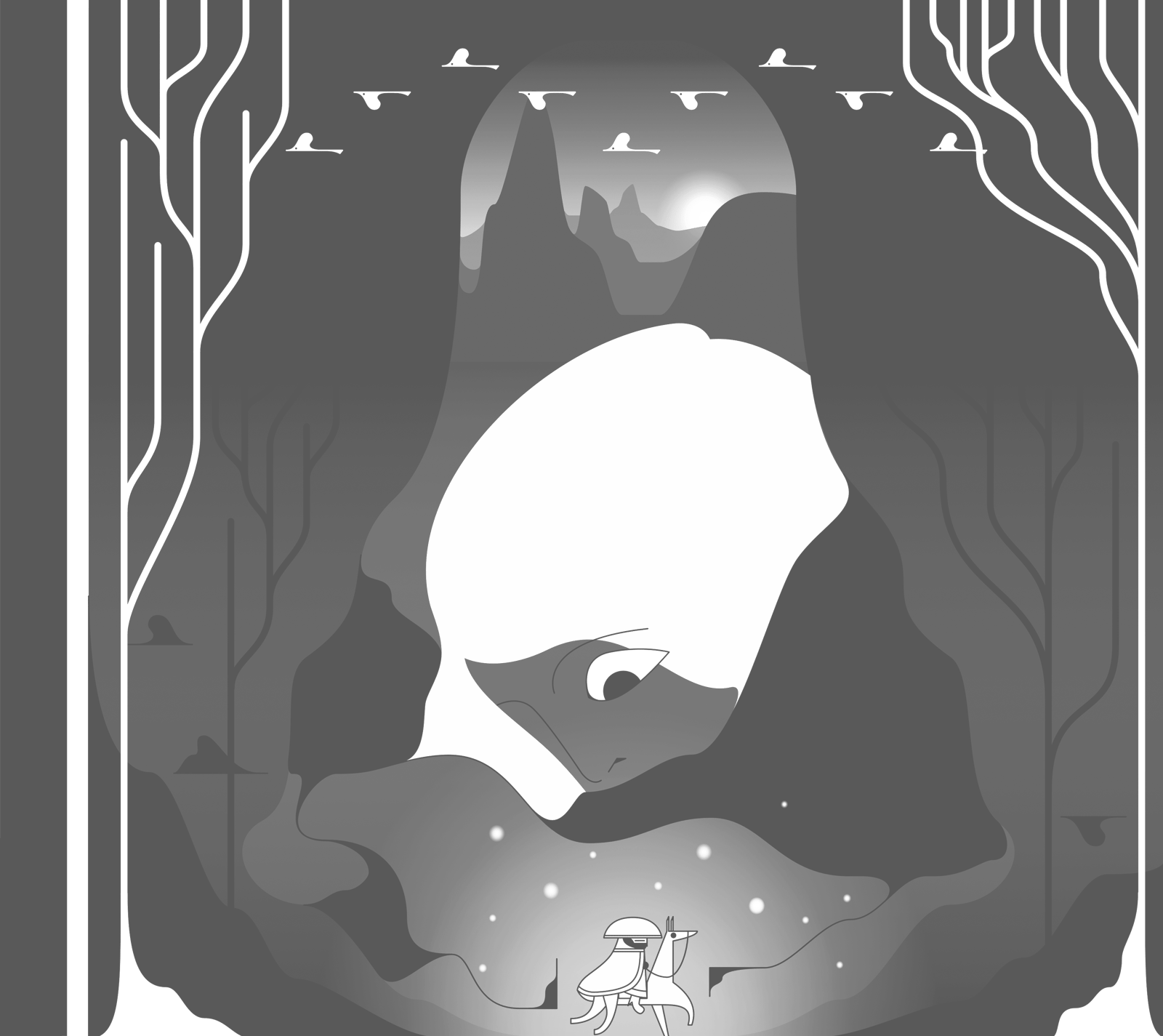
from cosmic horror to cosmic fun
With a keen interest for storytelling, rooted in myths and folk tales, and a sensibility for drawing, we started pyramid.ink in the early XXIth century as a way to shape our imaginary world into a setting to frame the stories we develop. This idea started a bit informal, with experimentations to develop a continuity and a style for illustrations and visuals, then was nurtured through a personal research in the fields of art theory and art history (especially sacred and decorative arts), illustrated literature, video games and co-constructed projects where our researches are confronted with different publics and grew.

The publication of the foundational story of the universe, Catabase, in 2020, and the work leading to it in the previous years, as a student of Metz Art School was an intense structuration moment of very diverse references, both visual and narrative, helped by wonderful teachers, art professionals and fellow students. In parallel, the lively underground art scene of the city was also a door to the broader underground French and European indie print scene, which had a big impact on our positioning. These relations also opened the doors of screenprinting and Risograph experiments we were hopeful to try someday for a long time. Atelier Barbotin (Rennes), Le mégot (Metz), ÖDL (Mulhouse), Fidèle (Paris), MyMonkey (Nancy), Quintal (Paris) all helped us discover and learn these techniques more precisely and their expertise was an immense help into shaping our printing practice.

The years that followed were mostly dedicated to confront our universe and stories to selected publics, through workshop based residency programs. Opportunities such as the Centre-Pompidou Metz young public workshop Sacrée Formes and the creative freedom and means of production that were given to us then were strong points of the period, and echoed through a few murals. In general the project evolved in the Grand Est French territory and neighbouring Germany, with a years spanning project where we made different sets of playing cards, with a successful crowdfunding campaign, and collected and wrote and made people write tales. Additionnally, research became more precise as it focused on graphic design and illustration (contemporary and historical), as it was needed for another endeavour, as a teacher in a Parisian bachelor program. Also, integrating l’atelier aux Lilas pour la typographie et l’estampe (Les Lilas) was a new step into structuring our printing practice, as it allowed the access to quality printing machines for Screenprinting and Blockprint, and opened experimentations to other techniques, such as photogravure and traditional type.
Starting in 2025 but cooking for a while, a new turn was made with the discovery of gdscript and the game engine Godot, and Metz friends from the third place Blida introducing us to the local video game scene, and the association East Games (Strasbourg). At this point, the old idea of making our world more lively and immersive through interaction started becoming real, and through East Games residency program Les Chiméride, and in collaboration with Programmer Lisa Hersant, we proposed our first interactive piece prototype Amarna to the public in July 2026. Following the presentation, we gave a try to html+css to present the current version of this website. The steady attendance to a specific stream for years also helped meeting people that were very helpful in being able to speak machine.

Curiosity is found in our focus on research: collecting stories, looking for references and inspiration everywhere in the history of arts, contemporary practices, and everyday life. We are always interested in listening to other’s stories, other places tales and myths, looking for obscure illustrator and designers with authored worlds and visuals. This research is also present in the experimental aspect of the project, such as the recent focus on interaction through coding, learning new frameworks and co. In workshop and interventions, the idea is to have curiosity go both ways: interest people in the benefits of expression through narration and facilitate the process through active and positive listening.

Accessibility is thinking our projects for all kinds of people, so everyone can enjoy aspects of the project, irregardless of their background or wealth. Maybe everything will not be accessible to everyone, but we try to diversify production so there is something for everyone. This translate in public workshop & interventions, limited print runs that makes pieces more affordable while retaining quality, and public projects such as murals, which all users of a place can see.

Craft is the underlying mindset of the project: we pay great attention in proposing slow & thoughtful processed artefacts, with a focus on authored vision and quality. This technical approach is also something we want to transmit and preserve through our workshops and interventions. This is done to increase people autonomy through tech literacy and preserve technical knowledges.

ÉSAL Metz / LISAA Paris / Groupe Scolaire Jean XXIII / Lycée Louis Vincent / CCF-FR, Centre Culturel Français Freiburg / Centre Culturel Franco-Allemand (CCFA) / Motoco Mulhouse / Centre Pompidou-Metz / Buro-GDS / Revue 303 / Revue Errratum / CCNRB / CNDB / Prix d'Art Robert Schuman / Galerie TATA / Chapelle BLP / Théâtre Universitaire de Dijon / Ateliers Médicis / Ville de Metz / Metz Métropole / Région Grand Est / East Games / Mira Cétii / Shitao Beats / Rhinocéros Sciences-Po / Unafam / Cofor / Hôpitaux de Charenton / CH Jury / Centre Hospitalier Jean Minjoz / GEM l'Albatross (Metz) / GEM Camille Claudel (Metz)